To Our Valued Patients,
The payment site is currently under maintenance, please call us to make a payment. This will be temporary until our processing company gets us a new payment link.
To Our Valued Patients,
The payment site is currently under maintenance, please call us to make a payment. This will be temporary until our processing company gets us a new payment link.

Medically Reviewed by: Christopher J. Hart, MD, FACS (NPI: 1295797371) & William H. Johnson, MD, FACS (NPI: 1669422010)
“Many of our patients from Johns Creek and Cumming come to us after years of relying on daily medications that only mask their symptoms. Our goal with laparoscopic reflux surgery — such as Nissen fundoplication — is to repair the mechanical cause of the reflux. By reinforcing the valve between the esophagus and the stomach, we can often provide a permanent solution that allows patients to stop taking PPls and return to a life without chronic heartburn.”
Dr. Christopher J. Hart & Dr. William H. Johnson
Gastroesophageal reflux disease (GERD), commonly known as acid reflux, affects up to 17 million Americans. It occurs when stomach acid flows back into the esophagus, causing irritation and discomfort.
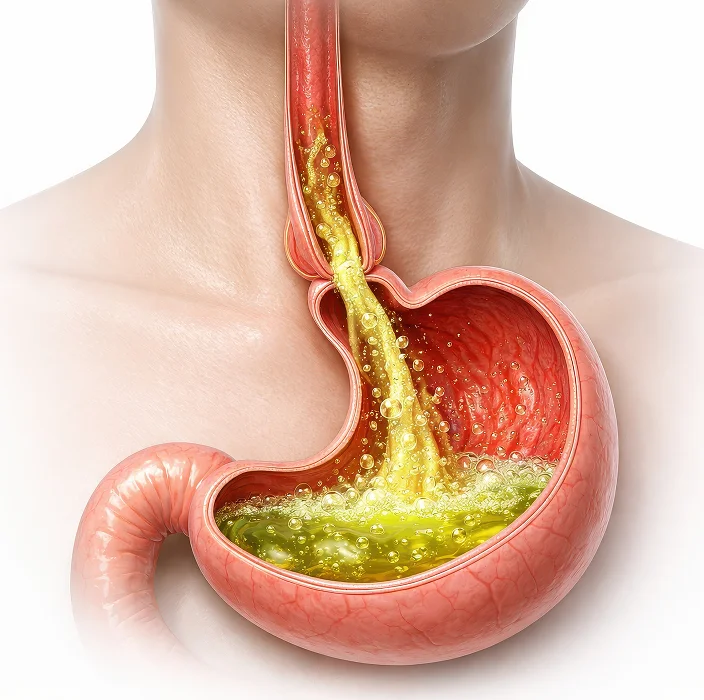
Over time, untreated GERD can lead to more serious conditions such as esophageal narrowing, ulcers, Barrett’s esophagus, or even cancer.

A muscle called the lower esophageal sphincter (LES) normally keeps stomach contents from moving upward. When this muscle weakens or relaxes improperly, acid can escape into the esophagus. Conditions such as a hiatal hernia, or when part of the stomach protrudes through the diaphragm and pushes into the chest, can make this worse.

Your doctor may recommend tests such as:
Then, they will recommend a GERD treatment plan, depending on the severity of your symptoms:

Option 1
Adjusting daily habits can often reduce symptoms. You may be required to:

Option 2
Over-the-counter and prescription options may be used to treat GERD, such as:

Option 3
Surgery is considered when symptoms persist or return despite medication. It may also be recommended if:
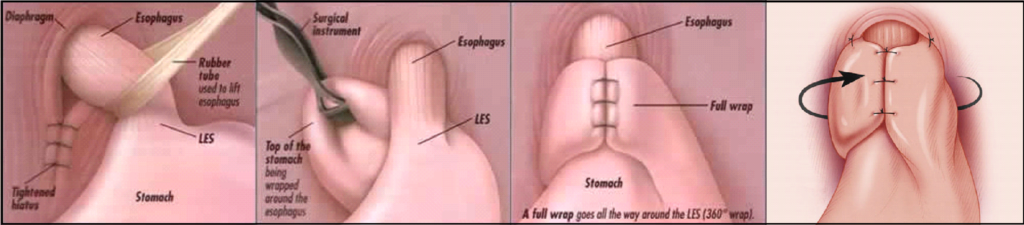
Fundoplication is a laparoscopic surgery for treating GERD when other treatments haven’t worked. Here’s what to expect with this common, effective procedure:
Surgery is typically recommended for patients who have a hiatal hernia, those whose symptoms are not well-controlled by medications (PPls), or those who wish to avoid a lifetime of daily medication. If you experience persistent breakthrough symptoms such as regurgitation or a chronic cough, a surgical evaluation with Dr. Hart or Dr. Johnson is advised.
At Johns Creek Surgery, we utilize minimally invasive laparoscopic and robotic-assisted techniques. This involves small incisions and a camera, allowing for high precision, less postoperative pain, and a much faster recovery than traditional open surgery.
Most patients return home the same day or the following morning. While you will follow a specific liquid-to-soft-food diet for a few weeks to allow the valve to heal, most patients return to light activities within a week and full activity within 2 to 3 weeks.
The primary goal of procedures like Nissen Fundoplication is to eliminate the need for daily GERD medications. While every patient's healing process is unique, the majority of our patients are able to successfully discontinue their PPls and H2 blockers following a successful repair.
Johns Creek Surgery, PC, located in Johns Creek, GA, serves patients across metro Atlanta, including Duluth, Alpharetta, Milton, Roswell, Gainesville, Canton, and Marietta. Our board-certified surgeons, Dr. Christopher Hart and Dr. William H. Johnson, perform outpatient procedures that do not require an overnight stay.